
UAE Pallet Sizes and Container Loading: How Many Fit, and the 20 mm Problem
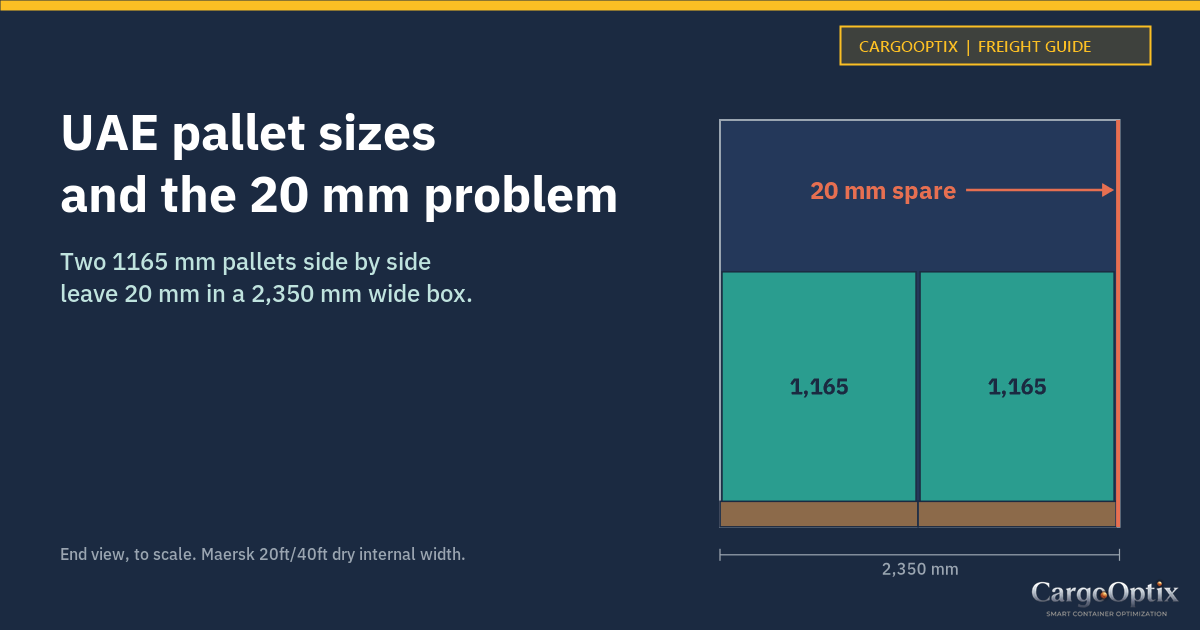
A standard 20ft container takes about 11 Euro pallets (1200 x 800 mm) or 10 pallets of 1200 x 1000 mm in one layer, and a 40ft takes roughly twice that. The square 1165 x 1165 mm pallet also fits 10 in a 20ft, but only just: two side by side measure 2,330 mm in a box that's about 2,350 mm wide inside. That leaves 20 mm. Lose it to overhang and the 20ft count can drop from 10 to 4.
Here's what sizes you're likely to meet in UAE warehouses, the real counts per box, and the checks that stop a pallet load turning into a re-work at the CFS.
Pallet sizes you'll meet in the UAE
We couldn't find a single mandated national pallet size for the UAE. What you'll see depends on the trade lane and the customer. UAE pallet suppliers list these formats:
| Pallet | Footprint (mm) | Where it comes from |
|---|---|---|
| Euro / EPAL | 1200 x 800 | ISO 6780, European flows |
| ISO / "industrial" | 1200 x 1000 | ISO 6780, widely used internationally |
| US GMA | 1219 x 1016 (48 x 40 in) | ISO 6780, North American flows |
| Asia square | 1100 x 1100 | ISO 6780, common in Japan and Korea |
| CP3 | 1140 x 1140 | ISO 6780 size, chemicals and IBCs |
| Square 1165 | 1165 x 1165 | Australian standard AS 4068 |
ISO 6780 defines six footprints: 1200 x 800, 1200 x 1000, 1219 x 1016, 1067 x 1067, 1100 x 1100 and 1140 x 1140 mm. The 1165 x 1165 isn't one of them. It's the Australian standard, designed for Australian rail containers that are wider inside than ISO boxes. It still turns up in the region, and Dubai suppliers stock it.
Before you palletise for export, ask the consignee what their racking and forklifts take. Then check it against the container, which is where the trouble starts.
How many pallets fit in a 20ft and 40ft container
We ran each footprint through a 2D floor-packing solver against Maersk's published internal sizes: 5,896 x 2,350 mm for a 20ft and 12,032 x 2,350 mm for a 40ft (a 40ft high cube has the same floor). These are single-layer, geometric maximums with exact footprints and no overhang.
| Pallet (mm) | 20ft | 40ft / 40ft HC | Notes |
|---|---|---|---|
| 1200 x 800 | 11 | 24 to 25 | Needs a mix of orientations |
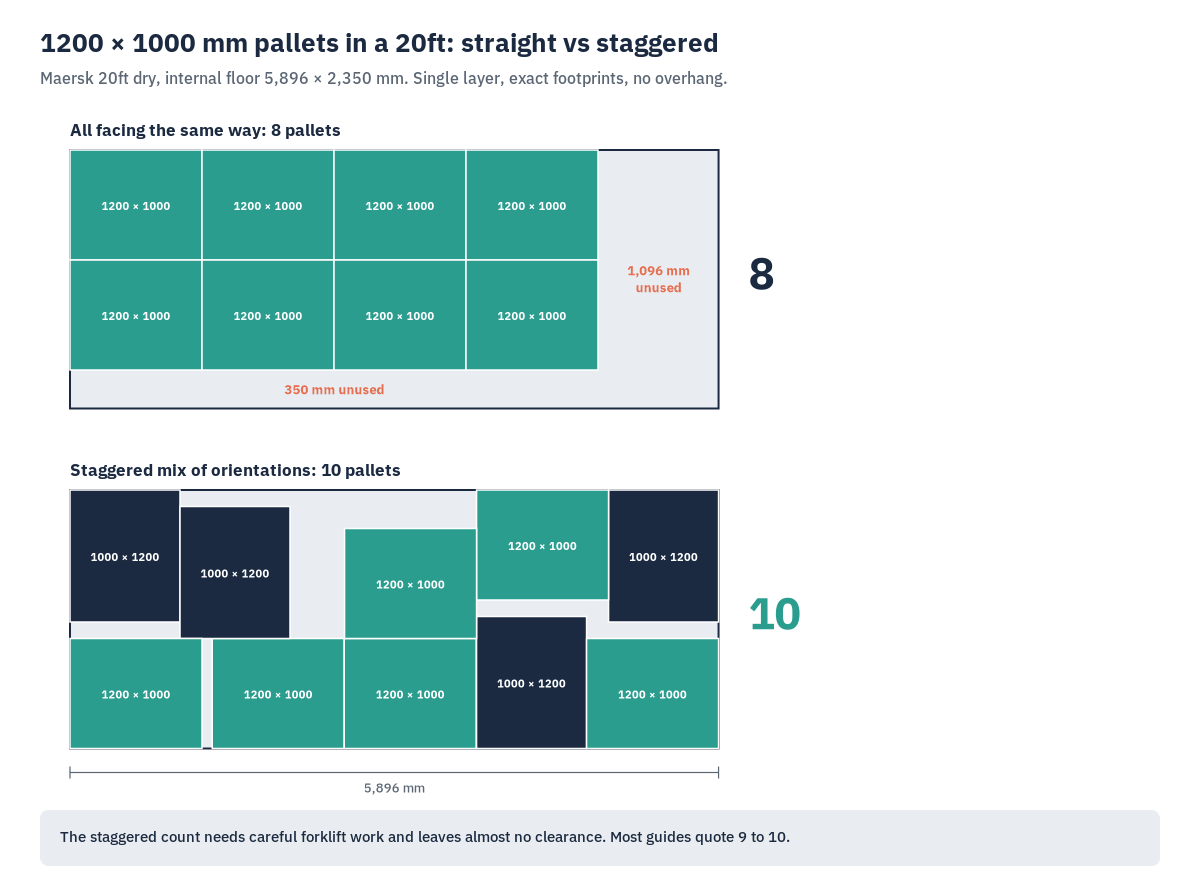
| 1200 x 1000 | 10 | 21 to 22 | 8 in a 20ft if all face the same way |
| 1219 x 1016 | 10 | 21 | |
| 1100 x 1100 | 10 | 20 | |
| 1165 x 1165 | 10 | 20 | Only 20 mm spare across the width |
Most published guides quote 9 to 10 pallets of 1200 x 1000 for a 20ft and 20 to 21 for a 40ft. That's consistent: the higher counts need a staggered layout and a careful forklift driver, and real loads need some clearance. Plan on the lower figure unless you've checked the layout.
You can run your own numbers in our free pallet and container calculators on the homepage.
The 20 mm problem
Two 1165 mm pallets side by side are 2,330 mm wide. How much room that leaves depends on the box:
| Container | Internal width | Spare width with two 1165 pallets |
|---|---|---|
| Maersk 20ft / 40ft dry | 2,350 mm | 20 mm |
| Hapag-Lloyd 20ft / 40ft (one series) | 2,352 mm | 22 mm |
| Hapag-Lloyd 40ft high cube (some series) | 2,342 mm | 12 mm |
| ISO 1496-1 minimum internal width | 2,330 mm | 0 mm |
Hapag-Lloyd also notes production tolerances of up to 10 mm on internal dimensions. So a box you've never seen could be tighter than its spec sheet.
Now add what happens on a real pallet:
- Overhang. Cartons that sit 10 mm past each pallet edge turn an 1165 footprint into 1185. Two across is 2,370 mm, which doesn't go into 2,350. Our solver drops a 20ft from 10 pallets to 4, and a 40ft from 20 to 10, because the pallets now have to go single file.
- Stretch wrap and bulge. Soft cartons bow out under load. A few millimetres per side is enough to use up 20 mm.
- Damaged or out-of-tolerance pallets. A cracked deck board or a pallet built a bit wide makes the same problem.
- Dents. A side wall pushed in by a previous load reduces the width exactly where you need it.
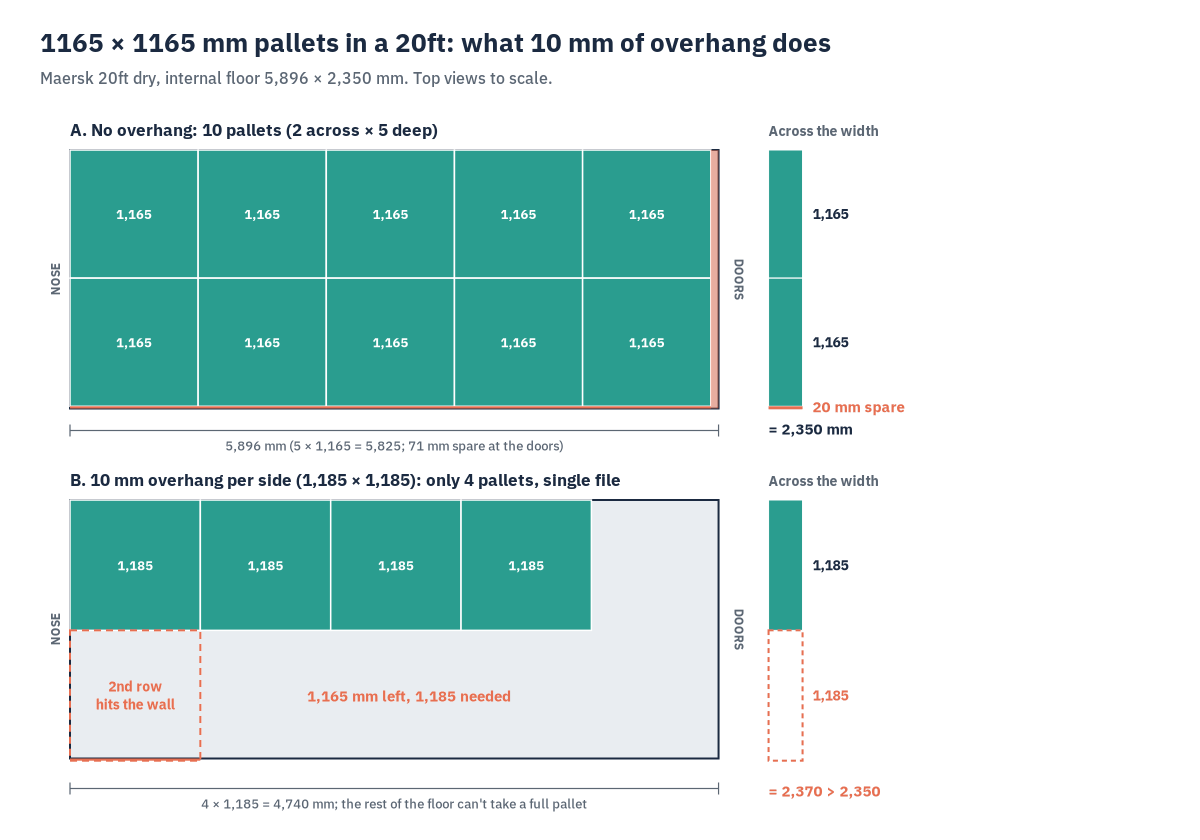
In practice nobody ships a 20ft with 4 pallets. What happens is a forklift driver fights the last pallets in, scrapes the wrap, or the CFS breaks pallets down and floor-loads cartons. That costs labour and time, and it's avoidable.
Compare 1200 x 1000 with the same 10 mm overhang (1220 x 1020 mm): our solver still finds 10 in a 20ft and 21 in a 40ft. The rectangular sizes leave more slack across the width, which makes them more forgiving.
If you have to use 1165 pallets, keep cargo inside the pallet edges, measure the loaded pallet, not the empty one, and ask for the actual container's internal width before you commit to 10 or 20.
Height: the door is lower than the roof
Floor space isn't the only limit. Pallets go in through the door, and the door opening is lower than the inside height:
- Standard 20ft and 40ft: about 2,393 mm inside, but the door is about 2,274 mm (Maersk) to 2,292 mm (Hapag-Lloyd) high
- 40ft high cube: about 2,697 to 2,700 mm inside, door about 2,577 to 2,597 mm
ISO 1496-1 sets the minimum door height at 2,261 mm for 8'6" boxes. The forklift also needs some lift clearance to set the pallet down, so the usable pallet height is lower again.
Double-stacked pallets need the two tiers plus lift clearance to fit under the door opening, because the stack, or the forks carrying the top pallet, has to pass through it. Two 1.1 m loaded pallets is 2.2 m, which is very tight in a standard box once you add lift clearance. The lower load also has to carry the upper one without crushing, and the total weight still has to stay inside the payload.
Weight per pallet and the gross-mass sum
Payload sets a ceiling per pallet. With Maersk's 28,200 kg 20ft payload spread over 10 pallets, the average limit is 2,820 kg per pallet. In a 40ft with 28,800 kg and 20 pallets it's 1,440 kg each. Heavy pallets, such as tiles or steel, often weigh out a 40ft long before it's full. Check the pallet's own rating too. A Euro pallet is commonly rated around 1,500 kg dynamic load.
The pallets themselves count toward the container's gross mass. The IMO guidelines on verified gross mass (MSC.1/Circ.1475) define gross mass as the container tare plus all cargo, pallets, dunnage, packing and securing material. A wooden 1200 x 1000 pallet commonly weighs in the region of 25 to 35 kg (check your supplier), so 20 of them add roughly 500 to 700 kg. Leave them out and your figure is wrong.
A pre-loading checklist
- Confirm the pallet footprint the consignee accepts.
- Measure loaded pallets at the widest point, including overhang and wrap.
- Get the actual box spec, or measure internal width at the door and mid-length if it's tight.
- Check loaded height against the door opening, minus lift clearance.
- Check weight per pallet against payload and the pallet's rating.
- Add pallet, dunnage and securing weights to the gross-mass sum.
- Decide the layout before the forklift arrives, not during.
Plan pallets before the forklift arrives
CargoOptix is a browser-based 3D load planner that covers containers, trucks and pallets. Its pallet planning includes EUR, US, Asia and UAE pallet standards. Bring your packing list in from a spreadsheet and it builds the 3D plan, a door-to-nose loading sequence, CBM, and gross-mass working to help you prepare SOLAS VGM figures. You get a PDF for the loading crew and a CSV out. The packing runs in your browser. See the features page for the full list.
You get a free 7-day trial, then one full plan a day for free. Passes, run packs and plans are on the pricing page.
Check your pallet load free for 7 days
Floor-loading cartons instead? See how many cartons fit in a 20ft or 40ft container. Running mixed pallets from several shippers? Read LCL consolidation planning without spreadsheets. More guides are on the blog.
FAQ
What is the standard pallet size in the UAE? We couldn't find one mandated UAE size. Local suppliers commonly list 1200 x 1000 mm and Euro 1200 x 800 mm, plus 48 x 40 in, CP sizes and 1165 x 1165 mm. Check what the consignee's racking takes.
How many pallets fit in a 20ft container? In one layer: about 11 Euro pallets, 10 of 1200 x 1000 with a staggered layout (8 if all face the same way), and 10 of 1165 x 1165 or 1100 x 1100, with no overhang.
How many pallets fit in a 40ft container? In one layer: around 24 to 25 Euro pallets, 20 to 22 of 1200 x 1000 depending on layout and clearance, 21 of 48 x 40 in, and 20 of 1165 x 1165 or 1100 x 1100.
What is the 20 mm problem? Two 1165 mm pallets side by side are 2,330 mm. A typical dry box is about 2,350 mm wide inside, leaving 20 mm. Overhang, bulging wrap or a narrower box can stop them going two across, cutting a 20ft from 10 pallets to 4.
Can you double stack pallets in a container? Only if both tiers plus lift clearance pass the door (about 2,274 to 2,292 mm in standard dry boxes), the lower load can carry the upper one, and the total stays within payload.
Sources
- Maersk, Dry equipment specifications (internal dimensions, door openings, payloads)
- Hapag-Lloyd, Container Specification (internal widths by series, door heights, tolerances)
- ISO 1496-1:2013 (minimum internal width 2,330 mm, minimum door dimensions) and ISO 6780:2003 (pallet footprints)
- Australian standard pallet, AS 4068 (1165 x 1165 mm), see Wikipedia summary
- IMO, MSC.1/Circ.1475 (definition of gross mass)
- Pallet counts: our own 2D floor-packing solver runs against the Maersk internal dimensions, exact footprints, no clearance
Try the 3D planner free for 7 days
Figures are planning aids, not a verified VGM declaration. See the Terms and Privacy Policy.