
20ft vs 40ft Container: How Many Cartons Actually Fit
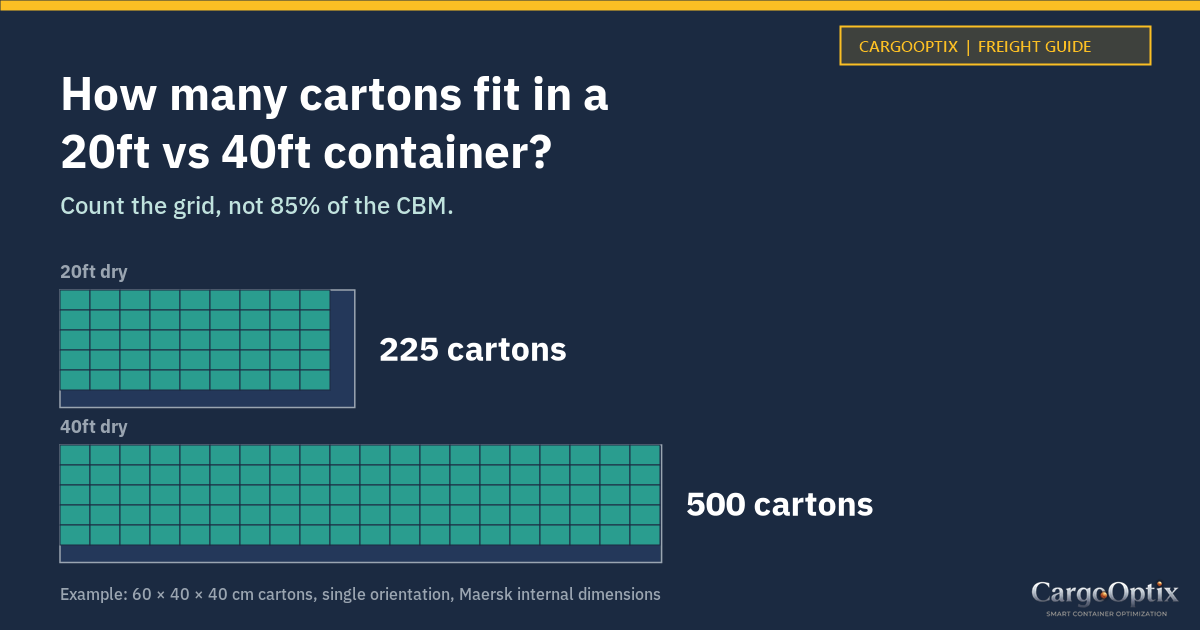
A standard 20ft container has about 33 m³ of internal space and a 40ft has about 67 m³, so a 40ft takes roughly twice as many cartons of the same size. The real count, though, depends on how your carton's length, width and height divide into the container's internal dimensions, not on a flat percentage. For a common 60 x 40 x 40 cm export carton that's 225 cartons in a 20ft if they all stand the same way up, and 500 in a 40ft.
Below: where those numbers come from, why the popular "85% rule" can overshoot by 30%, and why weight often decides first.
20ft vs 40ft container: the dimensions that matter
Container sizes are not identical across carriers or even across one carrier's fleet. ISO sets minimum internal sizes, and each manufacturing series lands a little differently. Here are published figures from two carriers:
| Spec | Maersk 20' dry | Maersk 40' dry | Maersk 40' high cube | Hapag-Lloyd 20' (one series) | Hapag-Lloyd 40' (one series) |
|---|---|---|---|---|---|
| Internal length | 5,896 mm | 12,032 mm | 12,032 mm | 5,900 mm | 12,032 mm |
| Internal width | 2,350 mm | 2,350 mm | 2,350 mm | 2,352 mm | 2,352 mm |
| Internal height | 2,393 mm | 2,393 mm | 2,697 mm | 2,393 mm | 2,395 mm |
| Door opening (W x H) | 2,350 x 2,274 mm* | 2,340 x 2,274 mm | 2,340 x 2,577 mm | 2,340 x 2,292 mm | 2,340 x 2,292 mm |
| Volume | 33 m³ | 67 m³ | 76 m³ | 33.2 m³ | 67.7 m³ |
| Tare | 2,280 kg | 3,700 kg | 3,880 kg | 2,300 kg | 3,700 kg |
| Max payload | 28,200 kg | 28,800 kg | 28,620 kg | 30,200 kg | 28,800 kg |
*Maersk's own documents list the 20ft door width as both 2,350 mm and 2,339 mm. That's exactly the point: treat every figure as nominal. Hapag-Lloyd notes production tolerances of up to 10 mm on length, width and height, and other series in its fleet have payloads as low as 26,700 kg for a 40ft. ISO 1496-1 only guarantees a minimum internal width of 2,330 mm and a door width of 2,286 mm.
If a load is tight, ask for the spec of the actual unit, or check its CSC plate when it arrives.
The quick estimate: container CBM divided by carton CBM
Most online answers use one formula:
Cartons ≈ container CBM ÷ carton CBM × 0.85
For a 60 x 40 x 40 cm carton:
- Carton CBM = 0.6 x 0.4 x 0.4 = 0.096 m³
- 20ft: 33.2 ÷ 0.096 = 345 theoretical, x 0.85 = about 293 cartons
- 40ft: 67.7 ÷ 0.096 = 705 theoretical, x 0.85 = about 599 cartons
Fine for a first guess on a call, and our free CBM and container calculators on the homepage do the sum for you. Just don't quote a customer or size a PO on it.
Why the 85% rule can be badly wrong
Cartons don't pour like liquid. They sit in rows, and every row either fits or it doesn't. So count the grid instead.
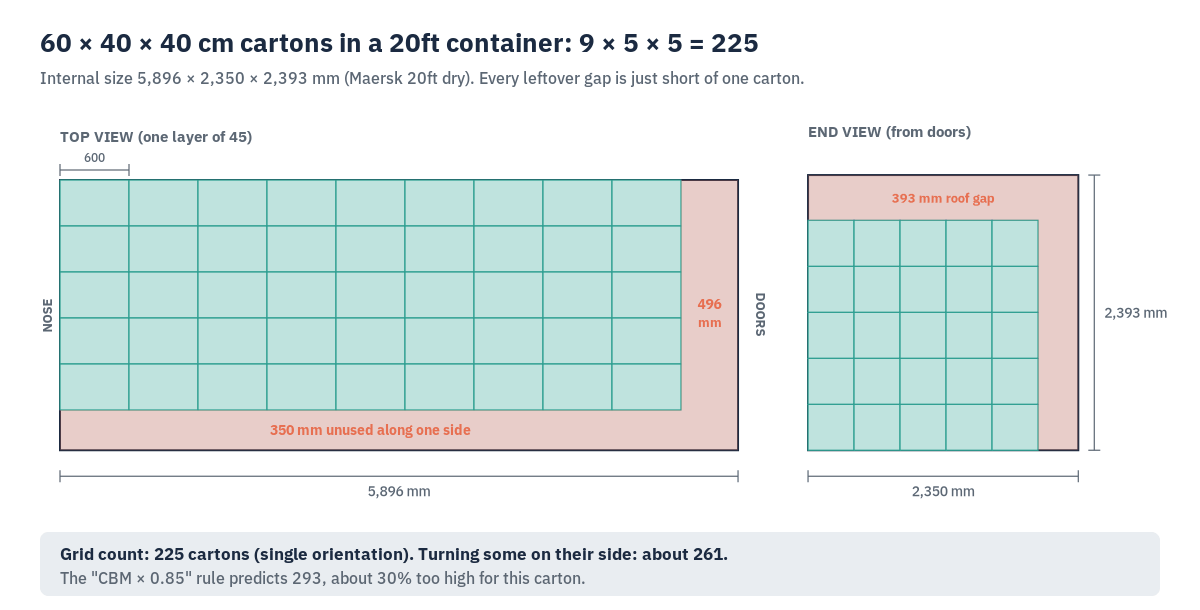
Take the 60 x 40 x 40 cm carton in a Maersk 20ft (5,896 x 2,350 x 2,393 mm), standing the long side along the container:
- Along the length: 5,896 ÷ 600 = 9 cartons (496 mm left at the door)
- Across the width: 2,350 ÷ 400 = 5 cartons (350 mm left)
- Up the height: 2,393 ÷ 400 = 5 layers (393 mm left)
That's 9 x 5 x 5 = 225 cartons, not 293. Every leftover gap is just short of one carton dimension, so the space is real but unusable in that orientation. If the cartons are allowed to lie on their side, you can fill some of those gaps with turned cartons and get to about 261. You still won't reach 293.
Here's how it plays out for three common carton sizes. "Single orientation" means every carton stands the same way. "Mixed" means cartons can be turned to fill leftover gaps, with zero clearance assumed, so treat it as a ceiling.
| Carton (cm) | Box | 85% rule | Single orientation | Mixed orientation (ceiling) |
|---|---|---|---|---|
| 60 x 40 x 40 | 20ft | 293 | 225 | ~261 |
| 60 x 40 x 40 | 40ft | 599 | 500 | ~560 |
| 60 x 40 x 40 | 40ft HC | 675 | 600 | ~660 |
| 50 x 40 x 30 | 20ft | 469 | 392 | ~492 |
| 40 x 30 x 30 | 20ft | 782 | 686 | ~774 |
| 40 x 30 x 30 | 40ft | 1,597 | 1,470 | ~1,630 |
These counts are our own grid calculations against the Maersk internal dimensions above. For some cartons the 85% rule is close. For others it overshoots by 30%. You can't tell which without doing the grid.
Notice the 50 x 40 x 30 carton: the mixed count beats the 85% rule. When your carton happens to divide neatly into 2,350 mm and 2,393 mm, you can fill well over 85%. When it doesn't, you can't get near it.
How to count cartons properly, step by step
- Start from the real box. Use the carrier's internal length, width and height for the equipment you're booking, not a generic 5.9 x 2.35 x 2.39 m.
- Try all six orientations. A carton has three dimensions and each can point along the length, width or height. Count the grid for each and keep the best.
- Respect "this way up". If the carton has orientation arrows, you only get the two orientations that keep it upright. That often costs a layer.
- Fill the leftovers. The 496 mm at the door or the 350 mm down one side may take a turned row. This is where a 3D planner earns its keep, because doing it by hand gets messy fast.
- Leave some clearance. Cartons bulge, walls have corrugations, and loaders need a few millimetres to slide the last row in. A plan that fits to the last millimetre on paper may not fit on the dock.
- Check the door. The door opening (about 2,274 to 2,292 mm high in a standard box) is lower than the 2,393 mm inside. Hand-stacked cartons don't care, palletised cargo does.
Weight: when the box is full before it looks full
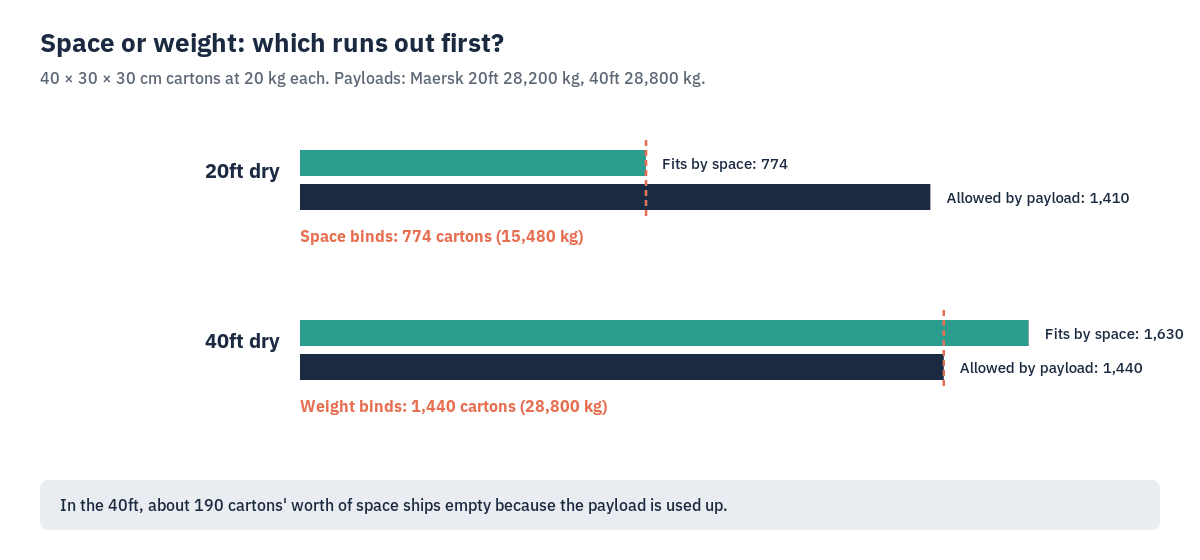
A 40ft has twice the space of a 20ft, but not twice the payload. Maersk lists 28,200 kg for a 20ft and 28,800 kg for a 40ft, only 600 kg more. So dense cargo runs out of weight long before it runs out of space.
Example with 40 x 30 x 30 cm cartons:
- At 20 kg each, a 20ft takes about 774 cartons, which is 15,480 kg. Space is the limit.
- In a 40ft, the space allows about 1,630 cartons, which would be 32,600 kg. The payload caps you at 28,800 ÷ 20 = 1,440 cartons. Weight is the limit, and about 190 cartons' worth of space ships empty.
- At 38 kg per carton (think tiles or canned goods), even the 20ft weighs out at about 742 cartons.
Two more things to watch. First, the container's payload isn't the only limit. Road weight rules where the box is trucked can bite earlier, so check with your haulier. Second, everything you put in the box counts toward the gross mass declared for SOLAS VGM: cartons, pallets, dunnage, securing material and the container tare. That's how the IMO guidelines (MSC.1/Circ.1475) define it.
20ft or 40ft: which one should you book?
A quick way to decide:
- Light, bulky cargo (garments, furniture, plastics): a 40ft or 40ft high cube almost always gives you more cartons per dollar of freight. The high cube's extra 304 mm of height can add a full layer, as with the 60 x 40 x 40 carton going from 500 to 600.
- Heavy, dense cargo (tiles, steel parts, bottled liquids): a 20ft is often the better box, because you'll weigh out a 40ft with space to spare anyway.
- In between: do both checks, space and weight, for each box type and see which limit you hit first.
Importing from China or India? Do this before you send the purchase order. Matching the carton count to the box is cheaper than finding out at the factory that 40 cartons won't go in.
Plan it in 3D before you book
The grid sum works for one carton size. Real orders have five SKUs, two of them heavy and one marked "this way up", and that's where hand counting stops being practical.
CargoOptix is a browser-based 3D container load planner. Paste or upload your packing list from a spreadsheet and it packs the cartons in 3D, gives you a door-to-nose loading sequence, CBM, and gross-mass working you can use when preparing VGM figures. You get a PDF loading guide and a CSV out. The packing engine runs fully in your browser, so your manifests and cargo data never leave your device. See the full list on the features page.
The trial is free for 7 days, and after that you keep one full plan a day for free. If you need more, pricing starts at $9.99 for a 24-hour pass.
Try your own carton list free for 7 days
If you're shipping palletised cargo, read UAE pallet sizes and the 20 mm problem next. If you consolidate cargo from several shippers, see LCL consolidation planning without spreadsheets. More guides are on the blog.
FAQ
How many cartons fit in a 20ft container? It depends on how the carton divides into the box (about 5,896 x 2,350 x 2,393 mm inside). For 60 x 40 x 40 cm cartons: 225 in one orientation, up to about 261 mixed.
How many cartons fit in a 40ft container? Roughly twice a 20ft. For 60 x 40 x 40 cm cartons: 500 in a 40ft standard, 600 in a 40ft high cube.
Is the 85% rule accurate? Only sometimes. For 60 x 40 x 40 cm cartons in a 20ft it predicts 293. A real grid gives 225 to about 261.
What's the payload of a 20ft and a 40ft container? It varies by unit. Maersk lists 28,200 kg (20ft) and 28,800 kg (40ft). Hapag-Lloyd lists 40ft series from 26,700 kg to 28,800 kg. Check the CSC plate or the carrier spec.
What's the door opening of a standard container? About 2,340 mm wide and 2,274 to 2,292 mm high for standard 20ft and 40ft boxes from Maersk and Hapag-Lloyd. High cubes are around 2,577 to 2,597 mm high.
Sources
- Maersk, Dry equipment specifications and Maersk Line equipment guide (20ft door width listed as 2,339 mm)
- Hapag-Lloyd, Container Specification (dimensions, payloads, tolerances)
- ISO 1496-1:2013, minimum internal and door dimensions for series 1 freight containers
- IMO, MSC.1/Circ.1475, guidelines on verified gross mass
- Carton counts: our own grid calculations against the Maersk internal dimensions above, zero clearance assumed
Try the 3D planner free for 7 days
Figures are planning aids, not a verified VGM declaration. See the Terms and Privacy Policy.